blog.hvacquick.com

All about ventilation and more…

Browsing Posts published by jake

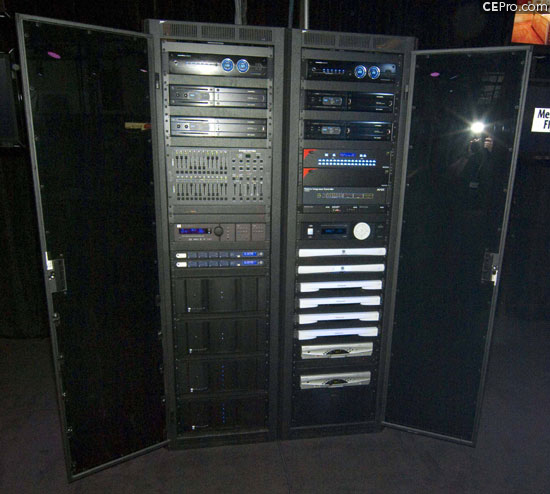
Todays high tech TV and sound systems have a lot of computing power and lots of amps to portray the sounds the Director wanted you to hear. A byproduct of all those components can be tremendous heat build up, which potentially could damage your equipment.

The best way to alleviate heat build up is of course to evacuate the air from the enclosure or room the equipment is in. Typically installers will install a thermostat in the room, then put a remote fan above or below connected with duct to pull air out.

S&P inline fans:
http://www.hvacquick.com/products/residential/AirFlow-Boosting/Inline-Air-Booster-Fans/SP-TD-Series-Inline-Fans

Of course we need cooler air to come in and replace what we have taken, so a popular solution is to install a grille down low in the access door. This allows air to come from the house and absorb the heat being produced. Sometimes we even add a filter to this door grille to keep the dust from building up on the components.

This will also work with servers, and other heat generating electronic equipment. Some benefits of proper heat dispersal is better performance and longer life of the pieces.

A concern shown by many clients is quiet operation of whichever fan unit they are purchasing. Remote fans clearly will assist with this as the fan is not located directly above you. There are other factors that can help with a quiet installation.

For bath fans, try to get at least 5-8 feet of flexible insulated duct between the fan and grille. We have found this ducting does a great job at minimizing noise and vibration transmission.

Kitchens are bit tougher since any fan moving the volume of air that they do will be louder. Typically a Fantech Silencer will assist in this matter quite well. Distance will also be your friend on these as the fans can typically be mounted anywhere in the duct run. Also, try to get a couple bends in the pipe between the fan and the kitchen. This will help bounce the sound waves back to the discharge side, and help keep things quiet.

For those of you doing general ventilation, boosting your HVAC airflow and other tasks, you can use a combination of the above and use a couple of the following:

If you are trying to boost airflow at a particular register, try to keep the fan back from the register by a few feet if possible.

Those with rigid duct would do well to replace a section around the fan with flex duct to help absorb some noise.

The use of a speed controller can help quiet a fan as well. You can purchase a fan with a little more power than you need and dial it back to suit your need.

The Kitchen…a place of interest for those of us who like to eat.

Most of us are familiar with the noisy, rattling, ineffective range vents usually installed in a home. These units typically have some form of fan and motor right above the range, causing all sorts of racket, and struggle to pull all the smoke from the fish that my wife I burned last night.

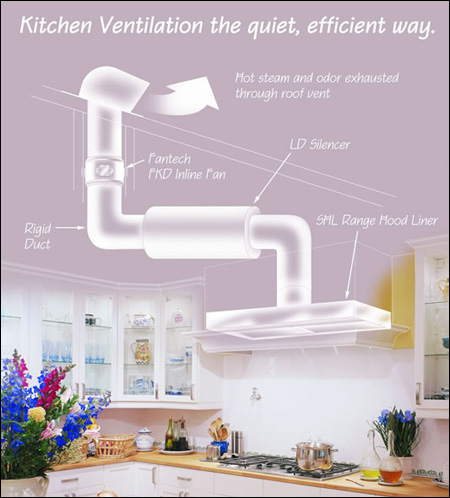
Is there a better way? You bet. Fantech Component Kitchen Exhaust systems. These have the a powerful fan located in the attic, coupled with a Silencer (muffler for the automotively inclined) that is able to pull massive amounts of air and do it without driving you from the kitchen with noise.

The ideal setup would have some sort of Hood Liner, a Backdraft Damper to prevent air from coming down the pipe when the Fan is off, the Silencer, The Fan and some sort of discharge hood in that order. All that is left is some hard wall galvanized pipe and you have a vent system that is unparalleled in terms of performance and quiet operation.

Sizing the system can be done by using our handy System Builder or a few simple rules of thumb:

  • The hood should be wider than the range.
  • Multiply the size of the hood to get surface area (36×22=792sq in)
  • Divide that by 144 to get square footage (792 sq in=5.5 sq ft)
  • Use around 75-100 CFM per square foot minimum to get the size fan you need

In this industry, CFM ratings are the “horsepower”, so to speak, that people use to compare products.

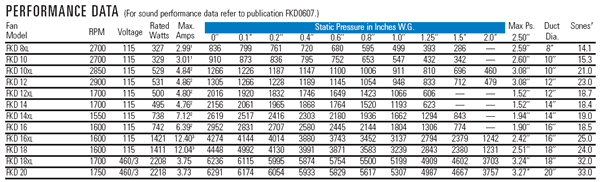
This statistic is used to measure how much air a fan can actually move. Here is the tricky part…Static Pressure. This is the number you see, usually measured in inches of water column, on those charts that show CFM for a given fan. Fine, what is it then?

In a word, resistance. That is, how much duct does the fan have to push or pull through? How many bends in the run? These are factors that can increase the Static Pressure and decrease the performance of the fan.

When fan shopping, be sure to compare apples to apples as some Manufacturers provide CFM at 0″ SP, while others may show what the fan could do under more adverse conditions such as .2″ or more. Which is more likely how it will perform when installed.

Here is a sample chart to let you see how things can change…

We believe that a well informed customer will always have a more gratifying experience. So in that regard, here is the 10 minute ‘expert’ course in airflow. What we won’t discuss for now are the human engineering aspects. Thermal comfort is a complex science.

What is CFM?

You see the numbers everywhere, what does it mean? CFM stands for cubic foot per minute. This term is used as a measurement of airflow rate for ventilation systems. The cubic foot refers to a cube of air 1 foot x 1 foot x 1 foot. CFM represents a volume flow rate, since we measure how many cubic feet are flowing by per minute.

Air is really, really light.

It takes 13.5 cubic feet (101 gallons) of air to weigh 1 pound. For a 2,000 square foot house, that means all the air in that house weighs 1,185 pounds – not much. Warming or cooling air is “low calorie”. To warm all that air in your house up from 50 degrees F to 70 degrees F takes about 5,688 BTU’s. The smallest house furnace puts out 40,000 BTU’s per hour. So how come it takes so long to heat up the house on a cold morning? (hint: you’re not just warming the air) An unsealed door jamb, leaking 50 CFM, would over the course of 24 hours, leak out 72,000 cubic feet of air – not “low calorie.”

Back in the old days, laundry rooms were put on an exterior wall, almost exclusively to provide a short vent run for the dryer. As our houses grew, somehow function trailed form and the unsightly laundry room was relegated to some hidden corner deep inside the house.

Works out for space usage, opening exterior walls for windows and the like…for the dryer, not so much.

Dryers need to shed heat and moisture to operate efficiently. More than 6 feet or so and they are over matched. Well…what now?

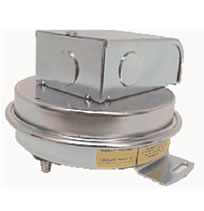
Dryer booster fans! These fans have pressure switches or current sensors to know when the dryer is running and turn on and off all by themselves. These fans have enough strength to keep the heat and moisture moving, allowing your dryer to dry clothes in the time it should.

How Do I Know If I Need One?

  • Takes a long time to dry your clothes?
  • Need to run the dryer multiple times?
  • Replaced your dryer because it burned out?

Tjernlund, Fantech, Soler Palau and others make great ones. Give a call to find out which one will work best for you…

Those of you living in High Rises or older homes have come up with a great way to beautify the interior of your home…covering up that unsightly steam radiator.

As you can see, there are a multitude of methods to do this. One of the most common ways we have seen is to surround it with a cabinet. The one problem is that heat wants to rise, and generally there is controls that need accessing from time to time…

HVACQuick has you covered! (Nice play on words, huh)

Behold!! The Bar Linear Diffuser! We can make these in very long lengths to cover any Radiator. Also, we can put operable doors on one or both sides to facilitate control access…

When people are looking to get a replacement grille or register for their home, the easiest question would be “what size do I need?”, or is it….

These grilles are custom built to fit. Fit what you ask? Well, since your old grille is not likely one we built, we cannot go by the outside dimension (flange to flange) as they vary by builder and model.

The dimension we need is the Actual Hole in your wall. Also, take a few measurements each way at a variety of locations. This will let you (and us) know the size that will fit best.