Seventy Years of Airflow

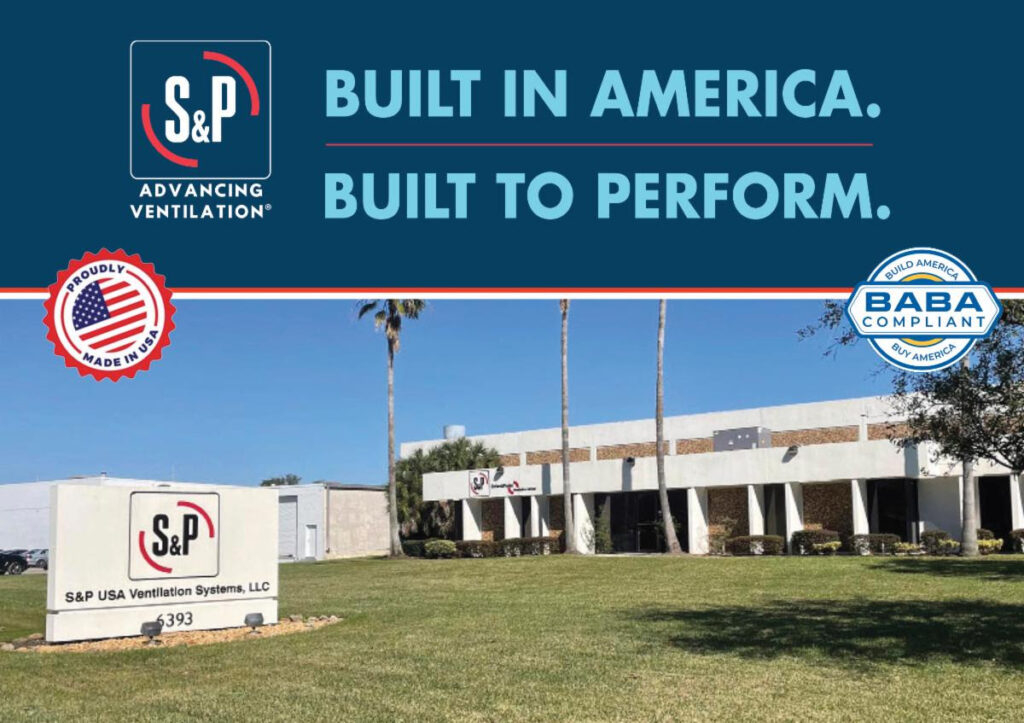
Few names in ventilation carry the history of Soler & Palau. In February 1951, Eduardo Soler and José Palau founded the company in Ripoll, Spain, building fans and single-phase controllers for industrial and commercial use. More than seventy years later, the Soler & Palau Ventilation Group is headquartered in Barcelona, operates manufacturing facilities in 12 countries, and has a presence in more than 90 countries with S&P USA based in Jacksonville, Florida.

Using steel and aluminum sourced from U.S. metal manufacturers, the Jacksonville team builds a broad range of American-made commercial ventilation products, including centrifugal fans, propeller fans, inline ventilation, relief hoods, and fresh air supply products. Choosing S&P USA commercial products supports American manufacturing, from the domestic suppliers who provide the materials to the skilled employees who build the products. Their products carry HVI, AMCA, UL, and ETL certifications, and their focus is simple: solving ventilation and indoor air quality challenges for both homes and commercial buildings.


TD-MIXVENT Series Inline Mixed Flow Duct Fans
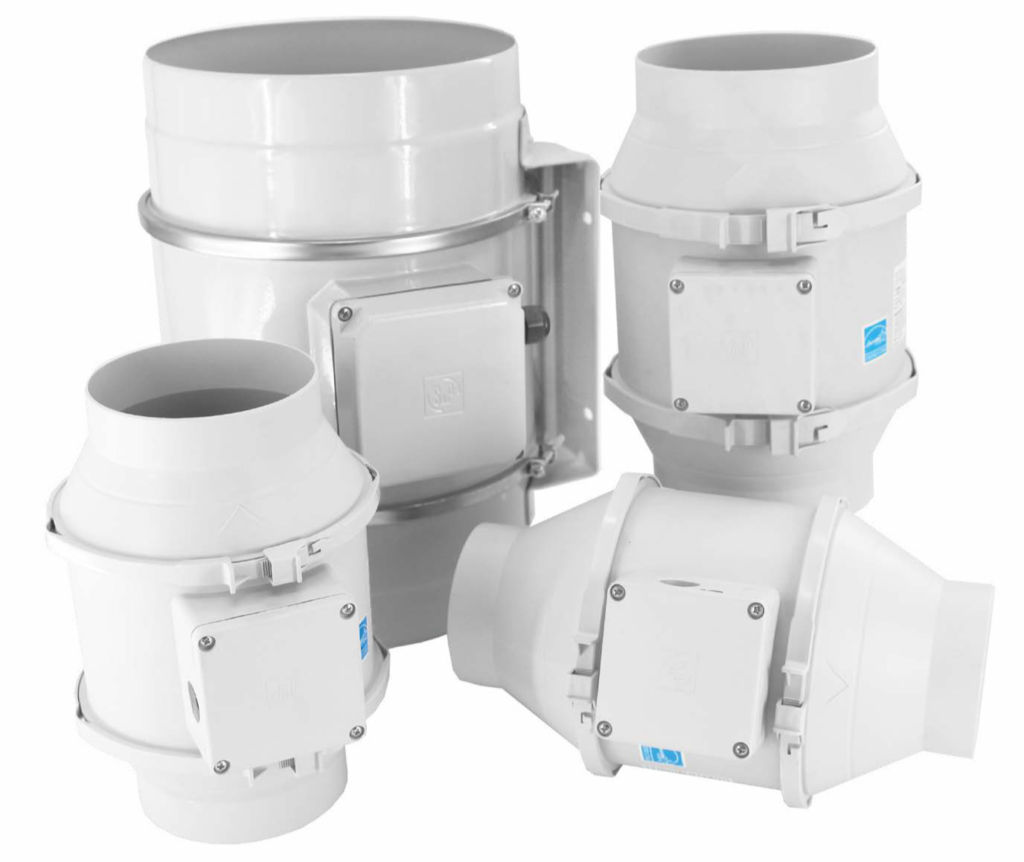
The TD-MIXVENT is built to deliver the most airflow from the smallest possible housing. A mixed flow impeller paired with internal guide vanes at the discharge produces smooth, laminar airflow that cuts turbulence and noise while holding a strong airflow to pressure ratio. With nine sizes from 4 to 16 inch duct, the series covers everything from a single bathroom to light commercial exhaust, and it fits where space is tight, such as drop ceilings and cabinets.

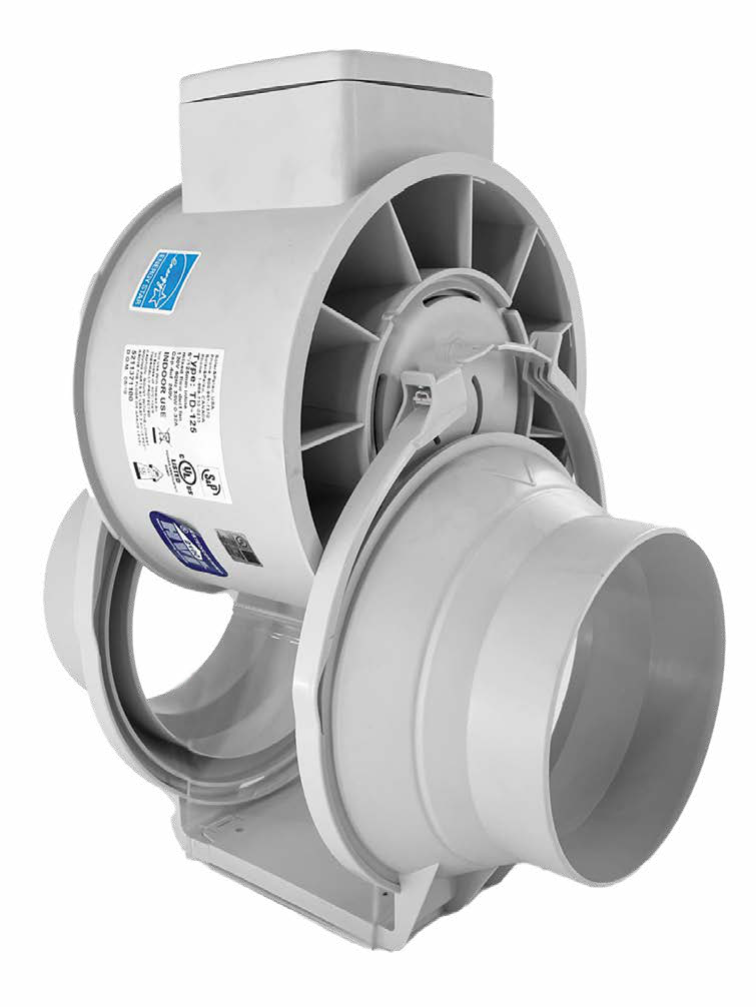
  • Removable Body: The motor and impeller assembly lifts out of the housing without disturbing the attached ductwork, so service and replacement take minutes. The terminal box rotates 360 degrees for easy wiring.
  • Construction: Models 100 through 150 use a tough reinforced polypropylene housing with ABS blades. Models 200 through 400 use galvanized steel with an epoxy-polyester coating, with aluminum blades on the 250 and up.
  • Motors: Permanently lubricated, sealed ball bearing motors rated for 40,000 hours of continuous operation, all suitable for voltage speed control. The TD-250 and TD-315 include dual speed (LS/HS) connections.
  • Listings: HVI certified, AMCA Seal for Air Performance, and cULus listed. The TD-100×1, 125, 150, and 200 are ENERGY STAR qualified. The TD-250 and TD-315 are UL listed for outdoor use, and the TD-355 and TD-400 are UL 507 and UL 705 certified.
  • Code Compliance: The TD-100, TD-100×1, and TD-150 are California Title 24 compliant and meet ASHRAE 62.2 when installed with a CVC control.
  • Warranty: 5 year limited warranty on the fan housing and motor. TD bathroom exhaust kits carry a 7 year warranty.
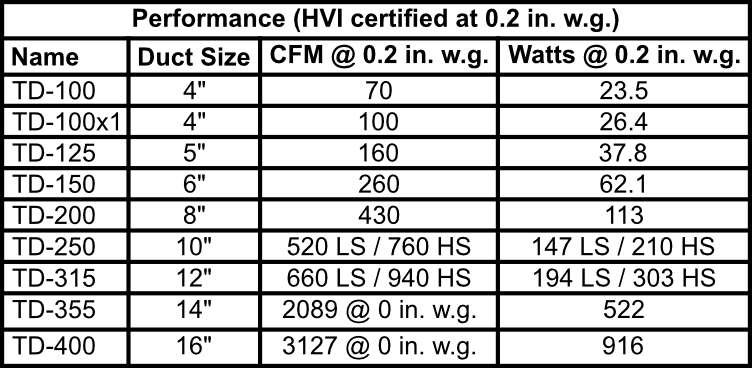
TD-MIXVENT Product Page | TD-MIXVENT Specs


TD-SILENT Series Extremely Quiet Inline Mixed Flow Duct Fans
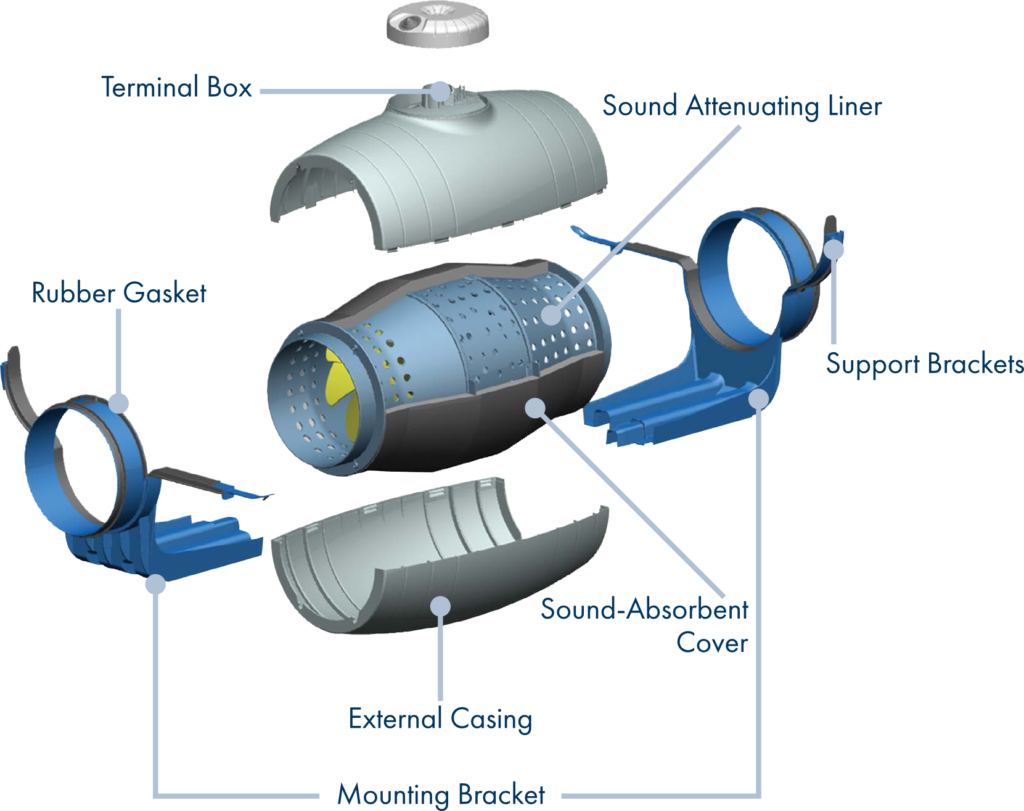
Some installations demand airflow without the noise. For fans located near bedrooms, offices, or media rooms, the TD-SILENT is engineered from the inside out for quiet operation. Sound waves pass through a perforated inner skin and are absorbed by a layer of sound-absorbent insulation before they reach the duct or the space around the fan.

  • Acoustic Construction: Reinforced plastic housing with a sound attenuating liner and sound-absorbent outer cover. Rubber gaskets on the inlet and outlet absorb vibration and provide a virtually air-tight seal.
  • Low Profile: Designed for installations with low height limits, such as suspended ceilings, with an integral mounting bracket, a removable body for service without disturbing the ductwork, and a terminal box that rotates 360 degrees.
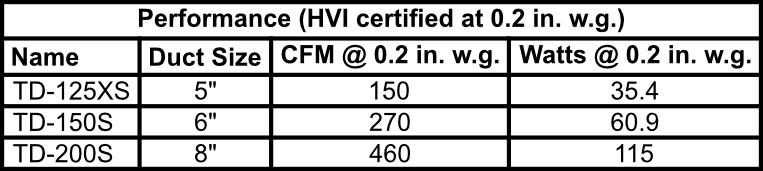
  • Motors: The TD-125XS uses a shaded pole motor with self-lubricating sleeve bearings. The TD-150S and TD-200S use permanent capacitor, external rotor motors with sealed for life ball bearings. All are rated for 40,000 hours and suitable for voltage speed control.
  • Listings: HVI certified, AMCA Seal for Air Performance, UL and cUL listed, and ENERGY STAR qualified. The TD-125XS and TD-150S are California Title 24 compliant and meet ASHRAE 62.2 when installed with a CVC control.
  • Warranty: 5 year limited warranty on the fan housing and motor.
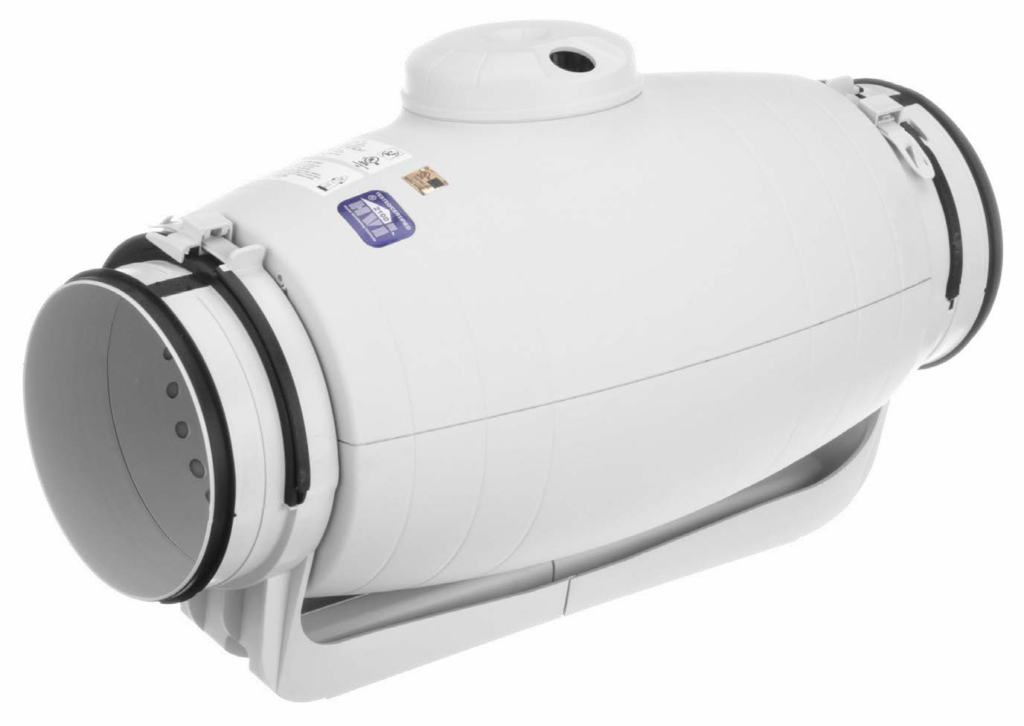
TD-SILENT Product Page | TD-SILENT Specs


MD6-ES24VK Outside Air Motorized Damper & Envirosense Ventilation Control Kit

Tight modern homes need a controlled path for fresh air to meet building code and ASHRAE 62.2. The MD6-ES24VK kit brings outdoor air into the return side of the central HVAC system through a 6 inch motorized damper, and lets the ES24V control decide when that air is worth bringing in.

  • How It Works: The damper installs between the fresh air wall cap, roof cap, or screened soffit vent and the HVAC return duct. When the ES24V calls for ventilation, the damper opens and the control can start the furnace blower to distribute fresh air through the existing ductwork.
  • Motorized Damper Specs: 6 inch round duct, 24V 60Hz, 0.3 A, 6 W, 50 dB or less. Mounts horizontally or vertically, indoors only, and handles conditioned or unconditioned airstreams from -40°F to 140°F (-40°C to 60°C).
  • ES24V Envirosense Control: Back-lit LCD and a simple four-button interface with Off, On, and Eco modes. Fan run time is adjustable from 5 to 60 minutes per hour in 5 minute steps.
  • Weather Lockouts: Included temperature and humidity sensors mount in the fresh air duct and check conditions every 10 seconds. In Eco mode, ventilation stops when outdoor air passes adjustable limits (high temperature 65 to 105°F, low temperature 20 to 60°F, high humidity 55 to 90%, low humidity 10 to 50%). Even during a lockout, the control runs the fan 5 minutes every 15 minutes to maintain ASHRAE 62.2-2010 compliance.
  • System Integration: Optional outputs for a duct heater and furnace blower, with a 24VAC supply. S&P recommends 20VA be available from the HVAC transformer to run the damper, or an auxiliary transformer or isolation relay if it is not.
  • Warranty: 5 year warranty on materials and workmanship.
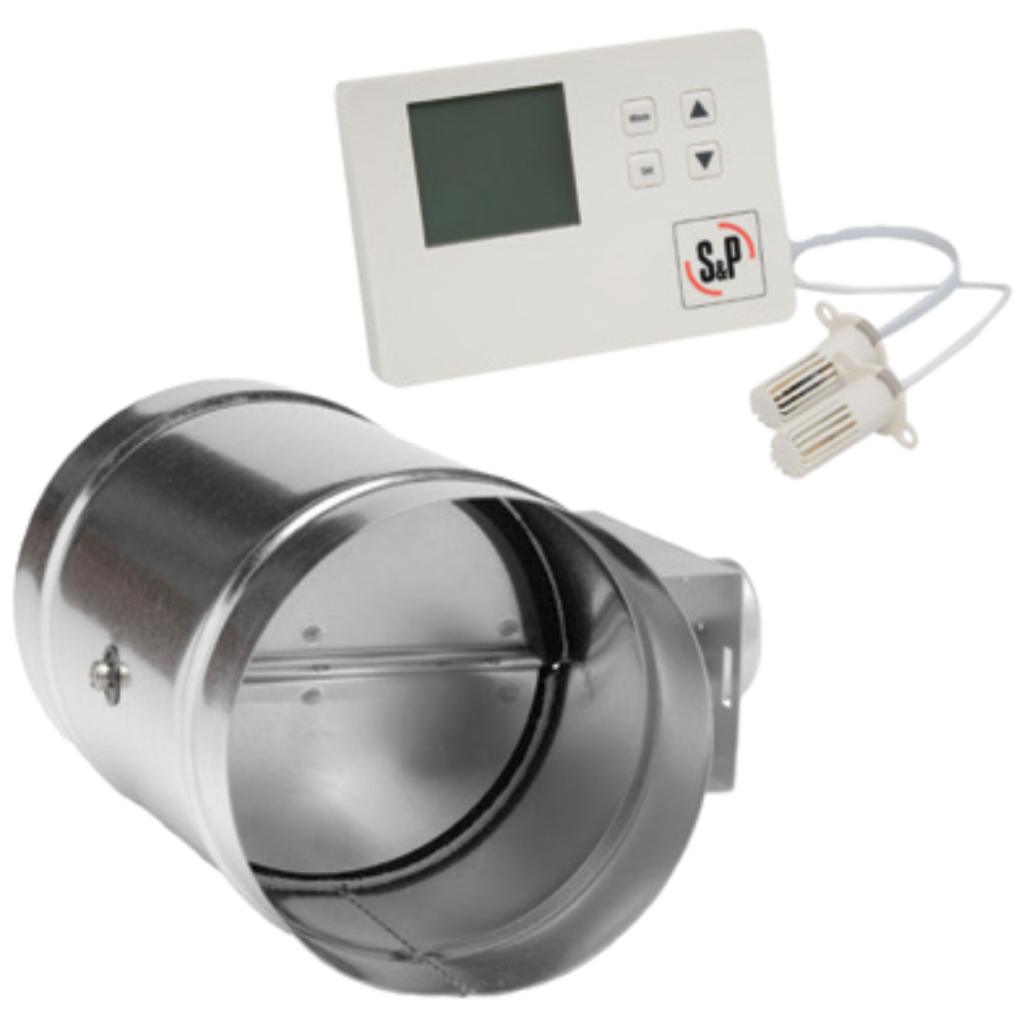
MD6-ES24VK Product Page | MD6-ES24VK Specs


S&P Commercial Ventilation

S&P USA’s Jacksonville team builds a broad range of commercial ventilation, from centrifugal roof exhausters to propeller wall fans. Here are two workhorses from that lineup.

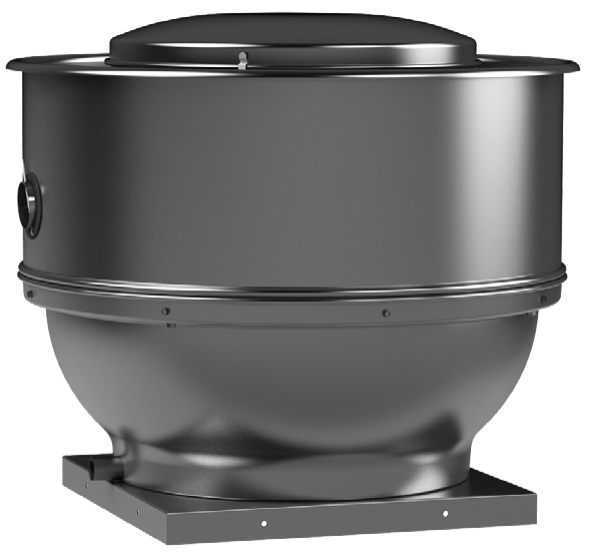
STXB Belt Drive Centrifugal Upblast Roof Exhausters

When the exhaust is greasy, contaminated, or hot, the STXB sends it straight up and away from the roof. The motor and drive sit in an enclosed, ventilated compartment isolated from the airstream, making it a go-to for restaurant hoods, kitchen exhaust, fume and smoke removal, lab fume hoods, and chemical process exhaust.

  • Performance: Up to 37,920 CFM at static pressures up to 3 in. w.g., in sizes 8 through 48.
  • Construction: Spun aluminum housing and curb cap with an integral deep spun inlet (galvanized steel curb cap on UL 762 and UL 793 units). The all aluminum, non-overloading backward inclined wheel is dynamically balanced, and neoprene isolators reduce vibration and sound.
  • Belt Drive: Lower operating RPM keeps sound levels down, and adjustable cast iron pulleys make it easy to fine tune airflow when balancing the system. Drives are sized for at least 150% of motor horsepower.
  • Listings: AMCA licensed for air and sound. cULus 705 listed, with cULus 762 for restaurant exhaust and cULus 793 for smoke control systems (500°F for 4 hours and 1,000°F for 15 minutes) available. Suitable for NFPA installations.
  • Options: EC motor version (STXBe) for 0-10V speed control from a building management system, high temperature STXB-HT and STXB-HT2 models, and a high wind option with Miami-Dade NOA, Florida Product Approval, and Texas Department of Insurance listing.
  • Warranty: 5 year bearing warranty on the standard STXB, with heavy-duty ball bearings sized for an L10 life over 100,000 hours.
STXB Product Page | STXB Specs


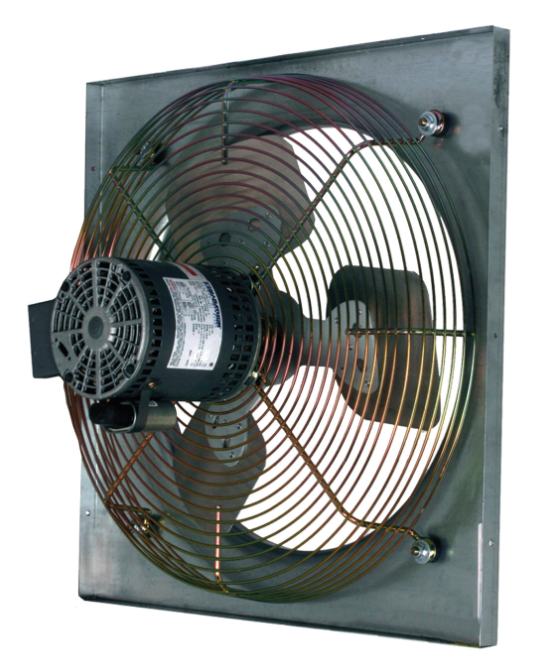
GED Direct Drive Sidewall Propeller Exhaust Fans

For moving large volumes of air at low static pressure, the GED is a simple, dependable wall fan. It provides general ventilation for warehouses, manufacturing and assembly plants, parking garages, gymnasiums, equipment rooms, and greenhouses.

  • Performance: 300 to 3,500 CFM at static pressures up to 3/4 in. w.g., in sizes 10 through 20 inch.
  • Construction: 16 or 18 gauge G-90 galvanized steel panel with a one piece spun venturi for maximum efficiency. Fabricated aluminum propeller blades mount directly on the motor shaft and are statically and dynamically balanced.
  • Easy Installation: Prepunched mounting holes, formed flanges for rigidity, an integral OSHA approved motor side guard, and suitable for all-angle installation. Every unit is factory run and tested before shipment.
  • eGED EC Motor Option: Converts single phase AC to DC for higher efficiency, offers 80% usable turndown versus 30% on a PSC motor, and moves up to 3,700 CFM.
  • Mounting and Accessories: Wall housings, filtered wall housings, and wall collars, plus gravity or motorized dampers, rainhoods, and safety guards. The same fan reverses its venturi to become the GSD supply fan.
  • Listings and Warranty: AMCA licensed for air and sound, with optional cULus 705 listing. 5 year fan housing warranty and 1 year motor warranty. Most sizes ship next day or within 10 days through the S&P Quickship program.
GED Product Page | GED Specs


The S&P Difference

Whether the job calls for a versatile inline fan in one of nine sizes, a fan quiet enough to install next to a bedroom, or a smart fresh air damper that responds to outdoor conditions, Soler & Palau brings more than seventy years of engineering to each solution. Every product featured here is backed by a 5 year warranty and built to help contractors and homeowners meet code and keep indoor air healthy. Explore the full Soler & Palau lineup at HVACquick.com.

Your dependable Partner for High-Performance products

Our engineering team is just a quick phone call away to provide expert guidance and ensure you have the right specialized gear for every job. Plus competitive contractor pricing, deep stocking and quick shipping from our East and West warehouses.

Join our TradePro program for below-MAP tier pricing, direct-dial engineering support and priority shipping.


Boosting Dryer Performance

A clothes dryer is designed to push air through a short, straight run of duct. Real homes rarely cooperate. Laundry rooms land in the middle of the house, on the second floor, or in a basement, and the exhaust has to travel through long runs and multiple elbows to reach the outdoors. Every foot of duct and every bend adds static pressure. The result is lower airflow, longer drying times, higher energy bills, extra wear on the dryer, and lint that settles inside the duct where it becomes a fire hazard.

An inline dryer booster fan solves the problem by adding the airflow the dryer cannot produce on its own.

When Is a Dryer Booster Needed?

Duct length is measured as equivalent length, which adds a penalty for every fitting. Both Suncourt and Atmosphere count each 90° bend (and Suncourt adds each screened exterior hood) as 5 feet of straight duct. Atmosphere recommends a booster once equivalent duct length passes these points:

  • No bends: 25 feet of duct
  • One 90° bend: 20 feet
  • Two 90° bends: 15 feet
  • Three 90° bends: 10 feet

This is a conservative rule. Many building codes allow longer runs before a booster is required, and dryer manufacturers publish their own limits, so always check the dryer installation manual and your local code.

Standard Booster or DEDPV?

Not every booster fan carries the same listing, and the difference matters for code compliance.

  • Dryer Exhaust Duct Power Ventilator (DEDPV): A booster listed to the DEDPV supplement of UL 705. These units add safety monitoring for a lint-laden, high-temperature airstream, such as indicator panels, blockage detection, and high temperature shutoff. Current building codes recognize DEDPVs specifically for extending dryer duct runs.
  • Standard duct booster: Safety listed as a general fan (UL 705 or UL 507) without the DEDPV supplement. These fans still move dryer air well, but they may not satisfy an inspector where the local code calls for a DEDPV.

If the job is going through inspection, specify a DEDPV-listed unit.

Pressure Switch or Current Sensor?

A booster needs to know when the dryer is running. Manufacturers use two methods.

  • Pressure switch: Senses the pressure the dryer creates in the duct and starts the fan. It needs no electrical connection to the dryer circuit, but S&P recommends mounting it within about 15 feet of the dryer outlet so it sees enough pressure, and wind, stack effect, and lint buildup can affect it.
  • Current sensor: Clips around the dryer’s power lead or mounts at the outlet or breaker and starts the fan whenever the dryer draws current. Suncourt and S&P both favor this method because it is maintenance free and unaffected by duct conditions.

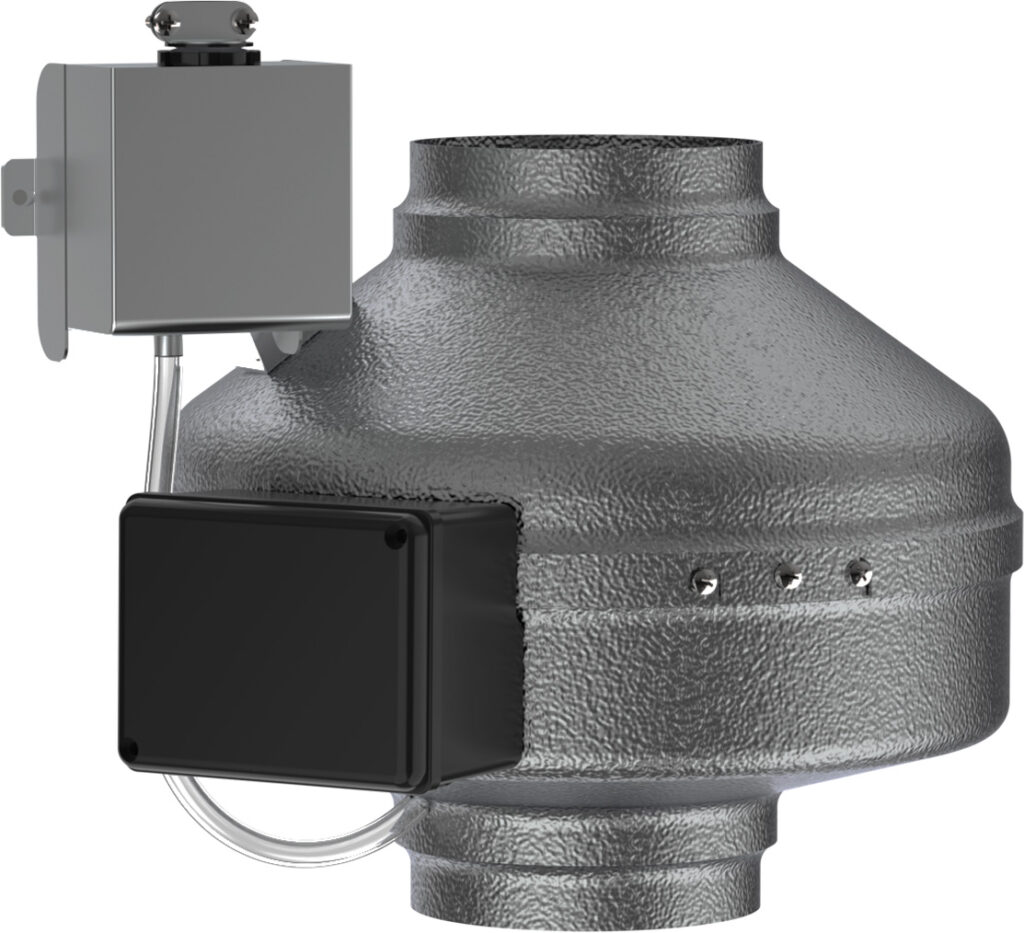
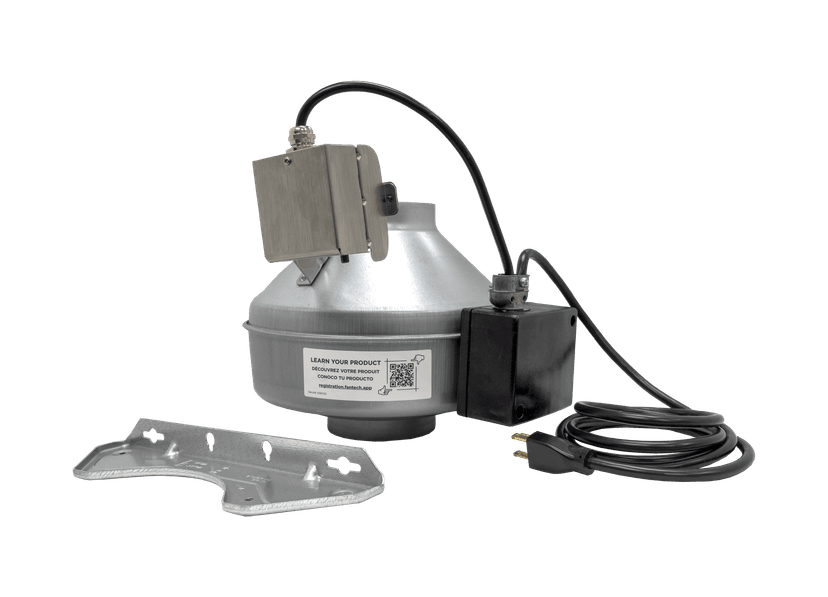
Fantech DEDPV-705 UL Listed Ventilator

Fantech’s DEDPV-705 is certified by Underwriters Laboratories to the DEDPV requirements of UL 705 and is UL listed for both gas and electric clothes dryers.

  • Duct Length: Supports up to 125 linear feet of 4 inch duct at sea level.
  • High Altitude Rated: Thinner air reduces fan performance, so Fantech publishes a maximum equivalent duct length by elevation:
    • 2,000 ft: 114 feet
    • 4,000 ft: 106 feet
    • 6,000 ft: 98 feet
    • 8,000 ft: 92 feet
    • 10,000 ft: 85 feet
  • Controls: Pressure-sensing switch for automatic operation with an indicator panel that shows product status.
  • Construction: Galvanized metal, leak-proof housing rated for air up to 167°F, with a 5 foot power cord for 120V.
  • Performance: HVI certified at 150 CFM at 0.20 in. w.g., 78 W.

DEDPV-705 Product Page | DEDPV-705 Specs


Suncourt Centrasense DRM04 DEDPV Clothes Dryer Booster Fan

Certified to the DEDPV supplement of UL 705 and CSA C22.2 No. 113, the Centrasense meets the 2015 IRC for residential electric dryers.

  • Duct Length: Suitable for dryer ducts from 25 to 100 equivalent feet.
  • Controls: Suncourt’s clip-on Easy-Mount Current Sensor provides a stable interlock with the dryer. The fan starts after a 3 second delay and stops 10 seconds after the dryer shuts off.
  • Monitoring: A remote indicator panel, flush mounted or mounted on a standard electrical box, shows duct system and fan status and flags low airflow, low RPM or high temperature limit, and an unplugged current sensor.
  • Serviceability: Duct cleanout sleeves allow periodic inspection and cleaning without removing the fan.
  • Installation: Approved for installation for electric dryers only.
  • Performance: 4 inch duct, 97 W.
    • 180 CFM at 0.2 in. w.g.
    • 115 CFM at 1.0 in. w.g.
    • 60 CFM at 1.4 in. w.g.
  • Warranty: 5 year limited warranty, 158°F air temperature rating with thermal overload and high temperature limit protection. Assembled in the USA.

Centrasense Product Page | Centrasense Specs


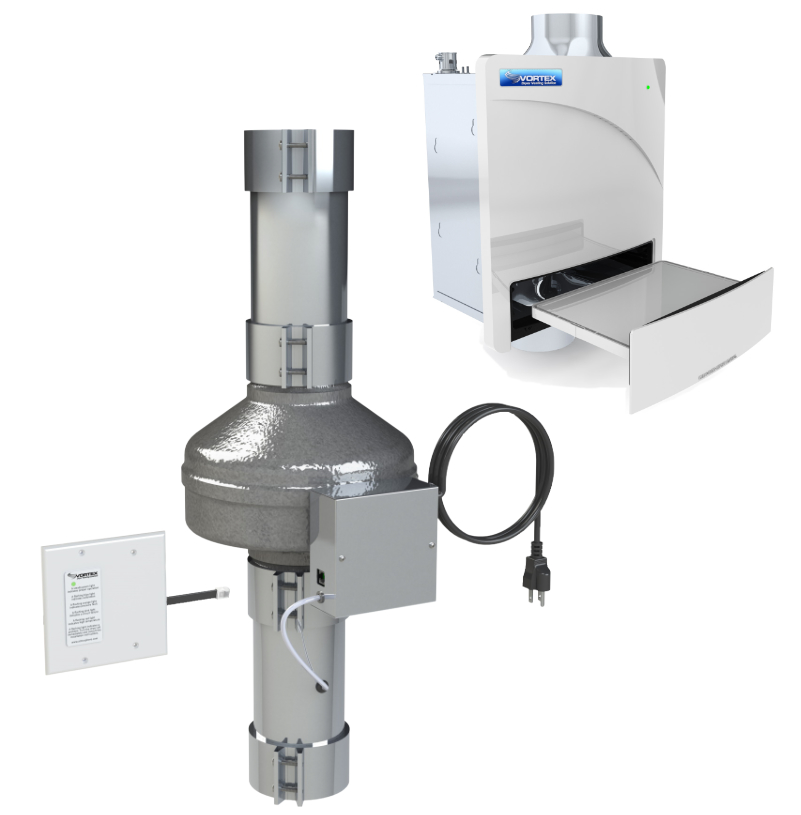
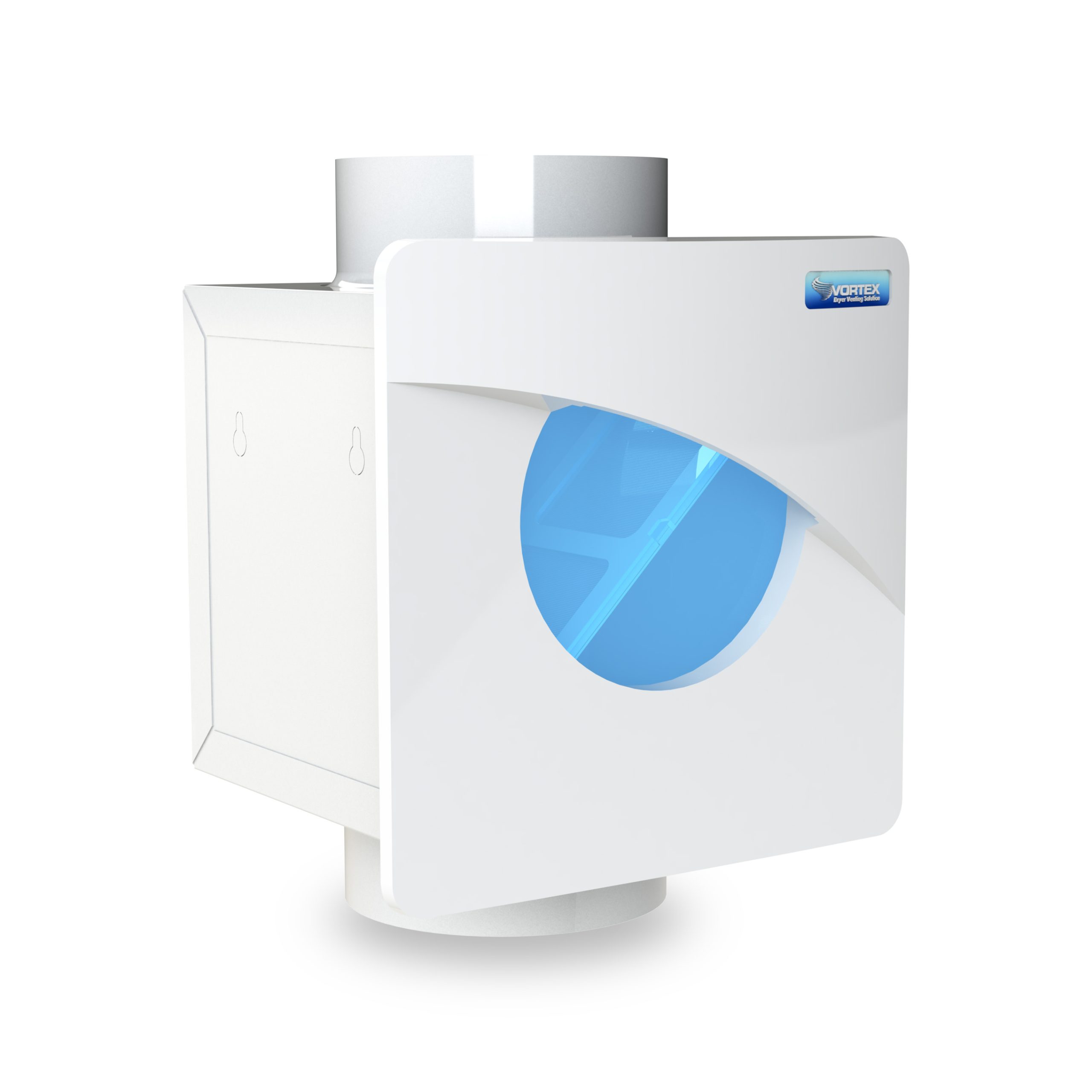
Vortex VTX-DEDPV and DBF-DEDPV Dryer Exhaust Duct Power Ventilators

Atmosphere’s DEDPV pair is certified to UL 705 and CSA C22.2 #113 Clause 12. Both energize automatically when the dryer runs and maintain an air velocity of 1,200 FPM to keep lint moving.

  • VTX-DEDPV: Inline round housing with a remote LED panel that confirms proper fan operation and alerts the user to a problem.
  • DBF-DEDPV: Wall cabinet style with the LED indicator on the front panel.
  • Safety: Both monitor internal pressure to detect and report a blockage, and a thermal fuse shuts the fan down in the event of a dryer fire.
  • Performance: 4 inch duct, 68 W.
    • VTX-DEDPV: 175 CFM at 0.2 in. w.g., 96 CFM at 1.0 in. w.g.
    • DBF-DEDPV: 176 CFM at 0.2 in. w.g., 105 CFM at 1.0 in. w.g.
  • Warranty: 10 years.


Product Pages: VTX-DEDPV | DBF-DEDPV

Specs: VTX-DEDPV | DBF-DEDPV


Vortex VTX400P and VTX400C Inline Dryer Boosters

For long runs where a DEDPV listing is not required, the VTX400 series delivers the highest airflow of the 4 inch fans in this lineup.

  • VTX400P: Built-in pressure switch runs the fan for 10 minutes, pauses for 15 seconds, and restarts if the dryer is still pushing air.
  • VTX400C: Current sensor with or without a 5 minute delay-off.
  • Performance: 4 inch duct, 80 W, 2,970 RPM.
    • 200 CFM at 0.2 in. w.g.
    • 119 CFM at 1.0 in. w.g.
    • 70 CFM at 1.5 in. w.g.
  • Listing: Conforms to UL 507 and CSA C22.2 No. 113, ETL listed, 10 year performance warranty.

VTX400 Product Page | VTX400 Specs


Fantech DBF Duct Booster Fans

Fantech’s DBF series uses a pressure-sensing switch on every model and is HVI certified for performance. These fans conform to UL 507 and are not listed to the UL 705 DEDPV supplement.

  • DBF 110: Plastic housing, supports duct runs up to 108 linear feet. HVI rated 160 CFM at 0.20 in. w.g., 66 W.
  • DBF 4XL: Galvanized metal housing with a 5 foot power cord, supports duct runs up to 125 linear feet. HVI rated 150 CFM at 0.20 in. w.g., 78 W.
  • DBF 4XLT: Everything in the DBF 4XL plus an indicator panel. HVI rated 150 CFM at 0.20 in. w.g., 78 W.

DBF Product Page
Specs: DBF 110 | DBF 4XL | DBF 4XLT


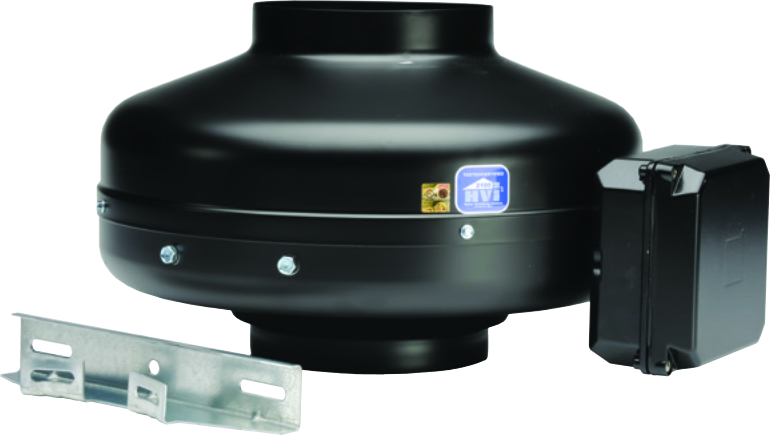
S&P PV-100x Dryer Booster Kits

The S&P PV-100x uses a backward curved metal centrifugal wheel on an external rotor PSC motor with sealed ball bearings, housed in galvanized steel with a black baked enamel finish.

  • Duct Length: Up to 105 linear feet of 4 inch rigid duct, or a maximum of 6 elbows and 80 feet.
  • Kits:
    • PV-100XPS: PV-100x fan, air pressure sensing switch with electronic cycle timing board, and mounting bracket.
    • DBF-100XC: PV-100x fan, CS-325 high current sensing switch, and mounting bracket.
    • PV-DEDPV: cULus 705 listed dryer exhaust ventilator, for use with gas or electric clothes dryers, 6 ft power cord
  • Performance: 130 CFM at 0.25 in. w.g., 80 CFM at 1.0 in. w.g., 84 W max.
  • Listing: ETL listed, AMCA seal for air performance, HVI certified, 5 year limited warranty.

PV-100x Product Page | PV-100x Specs


Suncourt DRY04 Centrax Dryer Boosting Kits

Suncourt’s original boosting kit includes the fan, mounting brackets, cable ties, and a current switch.

  • Duct Length: For 25 to 100 feet of equivalent rigid duct.
  • Construction: External rotor motor for quiet operation, backward inclined impellers that reduce lint buildup, 140°F rating, and thermal overload protection with automatic reset. Tested to UL 705 and CSA C22.2 No. 113.
  • Installation: Approved for installation for electric dryers only.
  • Performance: 40 W, 200 CFM at 0 in. w.g., 60 CFM at 1.0 in. w.g.
  • Warranty: 5 year limited.

DRY04 Product Page | DRY04 Specs


Vortex LT4 and LT4S Secondary Lint Traps

The dryer’s own lint screen does not catch everything. Airborne lint that slips past it collects in the duct and on the booster fan, where it restricts airflow and becomes fuel for a fire. A secondary lint trap installed between the dryer and the booster catches it first.

  • Construction: Powder coated 24 gauge galvanized steel box with a finishing frame for a clean wall installation.
  • LT4: Standard depth box with 4 inch round adapters.
  • LT4S: Low profile box with 4 inch oval adapters that fits inside a 2×4 wall.
  • Inspection Window: A 4 inch window shows lint accumulation at a glance, so you know when to clean the screen.

LT Product Page
Specs: LT4 | LT4S

Completing the System

A booster fan works best as part of a well built vent system. Pair it with the InOvate Dryerbox and MagVent connectors covered in our Optimizing Dryer Venting post to keep the transition behind the dryer short and crush free, and finish with a low resistance exterior termination.

Whether you need a DEDPV for an inspected new build or a high-output booster to rescue an existing long run, the right fan restores airflow, shortens drying times, and keeps lint moving out of the home. Explore our complete line of dryer boosting products at HVACquick.com.

Your dependable Partner for High-Performance products

Our engineering team is just a quick phone call away to provide expert guidance and ensure you have the right specialized gear for every job. Plus competitive contractor pricing, deep stocking and quick shipping from our East and West warehouses.

Join our TradePro program for below-MAP tier pricing, direct-dial engineering support and priority shipping.

The Invisible Danger

Imagine an invisible, odorless, and tasteless gas silently seeping into your home, posing a serious threat to your health. This isn’t a plot from a sci-fi movie; it’s the reality of radon, a naturally occurring radioactive gas that can be found present in any house, new or old, anywhere in the world.

Understanding radon, its risks, and how to combat it is crucial for every homeowner.

What is radon and why should you care?

Radon is a radioactive gas that comes from the natural breakdown of uranium in soil, rock, and water. It’s found in all 50 states and can exist in varying concentrations in the ground beneath your home. When it decays, radon releases tiny, radioactive particles that, when inhaled, can damage the cells lining your lungs.

The most significant health impact of radon is its direct link to lung cancer. According to the EPA, radon is the second leading cause of lung cancer overall, right after smoking. Long-term exposure to elevated radon levels dramatically increases your risk of developing this deadly disease, and because you can’t see or smell it, the only way to know if your home has high radon levels is to test for it.

How does radon sneak into your home?

Radon enters your home through various pathways, often exploiting the natural differences in air pressure between your house and the soil beneath it. Your home often acts like a vacuum, drawing air (and radon) from the ground:

  • Construction joints: Gaps where concrete sections meet allow radon to seep through.
  • Cavities and cracks inside walls: Openings within block walls or plaster cracks can draw in soil gas
  • Sump pumps: Unsealed covers over sump pits provide a direct pathway from soil to air.
  • Cracks in solid floors: Fractures in concrete slabs offer direct routes for radon gas to enter.
  • Gaps around service pipes: Openings where pipes penetrate floors or walls create easy entry points.
  • Gaps in suspended floors: Unsealed spaces around floorboards or access points in crawl spaces allow radon up.
  • Private wells and groundwater supplies: Radon dissolved in well water can be released into indoor air during use.

Essentially, any opening that connects your home’s interior to the soil beneath it can be an entry point for radon.

Radon Resources

The Indoor Environments Association (IEA), once known as AARST, is a leading non-profit professional organization dedicated to protecting public health from radon.

Their significance towards radon lies in several key areas:

Scientific Research: IEA has 4 decades of rigorous scientific research and have definitively established radon as a major cause of cancer mortality in the U.S.

Developing National Standards: accredited by ANSI, IEA develops and maintains national consensus standards for radon measurement and mitigation, vital for providing standardized approaches for every building type to ensure effective radon reduction and long-term protection.

Public Health Advocacy: They advocate for public health by emphasizing that an individual’s radon exposure accumulates over time, increasing the risk of preventable lung cancer. Their work aims to ensure that effective measurement and mitigation practices are adopted to safeguard occupants.

Data and Reporting: IEA compiles and publishes reports, such as the Radon Report Card, which provides state-by-state data on radon levels, health impacts, and policy requirements, further highlighting the widespread nature of the radon issue.

IEA’s work underscores that preventing radon exposure is one of the most important environmental health challenges we face today, advocating for standardized measurement and mitigation practices to safeguard occupants.

Monitoring Radon Levels in the Home

SunRadon Lüft® Pro

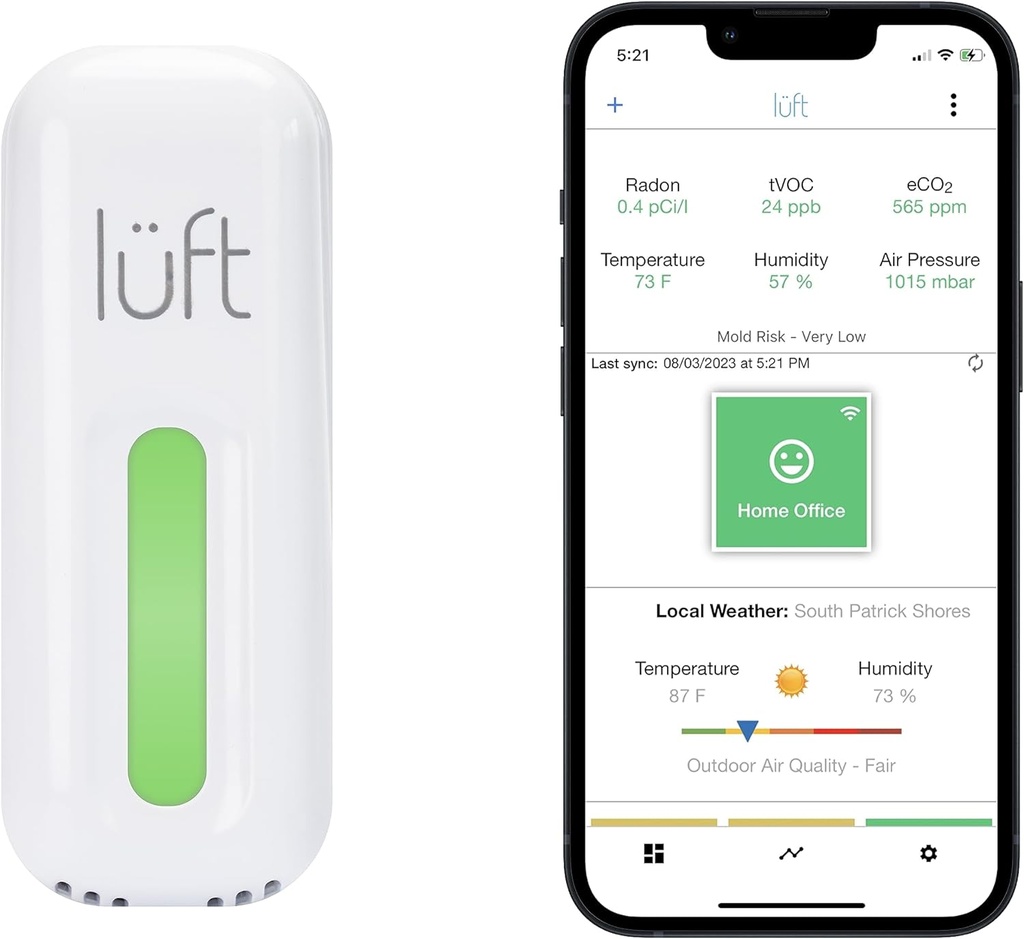
SunRadon’s Lüft Pro gives homeowners continuous peace of mind by transforming complex sub-slab soil gas monitoring into an automated, plug-and-play visual status system.

  • Continuous Monitoring: With 24/7 monitoring, notifies if there is a sudden increase in radon levels, indicative of a mitigation fan failure.
  • 6-in-1 Multi Sensor: Not only monitors radon levels, it also monitors VOCs, CO2, barometric pressure, temperature, and relative humidity.
  • Zero-Calibration Plug-in Design: Fits into standard wall outlets without batteries, mounting hardware, or scheduled calibration maintenance.
  • Lüft Mobile App: Provides easy access to monitor your Indoor-Air-Quality from anywhere and anytime. Traffic light color coding of the sensor readings quickly visualizes elevated or even dangerous readings.

Lüft® Pro Product Page | Lüft Pro® Specs

How Radon Fans Mitigate the Risk

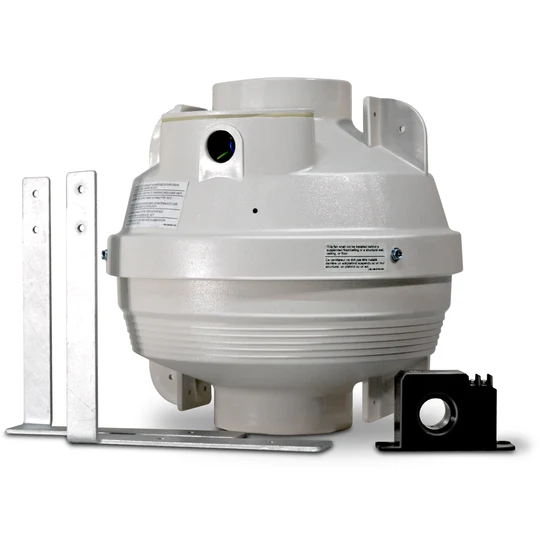
Once testing reveals elevated radon levels, a radon mitigation system is installed, and at its heart is the radon fan. These specialized fans are the active component that tackles the problem head-on:

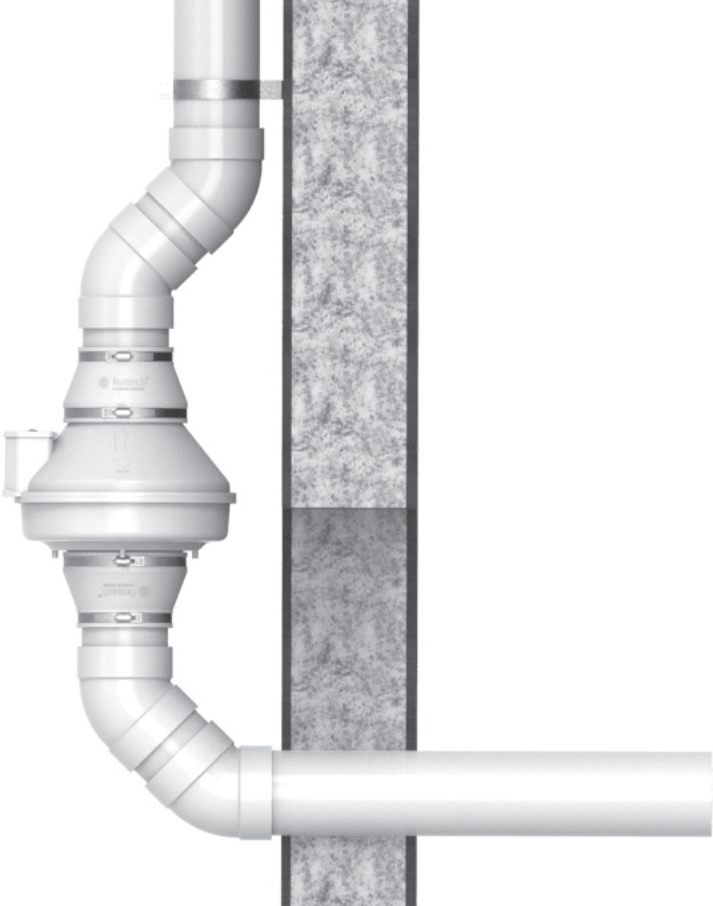
  • Creating a “Vacuum” Beneath Your Home: The most common and effective mitigation method is called “sub-slab depressurization” or SSD. A PVC pipe is installed through the foundation slab and connected to the radon fan. The fan then creates a continuous, slight vacuum beneath your home’s foundation.
  • Drawing Radon Away: This negative pressure effectively draws radon gas from the soil and gravel underneath your home before it can ever enter your living space.
  • Safe Venting Outdoors: The fan continuously pulls this radon-laden air through the pipe and safely vents it outside, typically above the roofline, where it quickly disperses harmlessly into the atmosphere.
  • Continuous Protection: Radon fans are designed to run 24 hours a day, 7 days a week, ensuring that the dangerous gas is consistently removed from beneath your home, maintaining safe indoor radon levels.

By actively and continuously removing radon, these fans act as an unseen shield, transforming your home into a safer environment and significantly reducing the risk of radon-induced lung cancer for you and your family.

Choosing your defense

While understanding how radon mitigation works is vital, selecting the right equipment is equally important for long-lasting protection. At HVACquick, we partner with leading manufacturers known for their reliability and performance in radon reduction.

When it comes to top-tier radon fans and mitigation supplies, two names stand out:

Fantech: A pioneer in ventilation with over 40 years of experience dedicated to healthy indoor air, Fantech introduced the first inline radon fan to the U.S. in 1983, the first EC radon fan on the market. Their Rn series radon fans are engineered for robust construction, airtight reliability, and efficient performance, making them a trusted choice for a wide variety of sub-slab conditions. Fantech’s commitment to quality and innovation positions them as a leading provider of dependable radon mitigation solutions.

RadonAway: Founded in 1990 by Spruce Environmental Technologies, Inc. and based in Massachusetts, RadonAway offers the industry’s most diverse and rigorously tested line of radon fans and integrated mitigation solutions. They empower professionals with innovative product development, comprehensive system design support, and deep-rooted industry leadership, ensuring effective and reliable radon reduction for every project. Their extensive range means there’s a RadonAway fan designed for virtually any home’s specific needs.

Don’t let radon remain an invisible threat. Test your home, and if elevated levels are found, a professional radon mitigation system with a reliable radon fan is your best defense for peace of mind and healthy living.

Your dependable Partner for High-Performance products

Our engineering team is just a quick phone call away to provide expert guidance and ensure you have the right specialized gear for every job. Plus competitive contractor pricing, deep stocking and quick shipping from our East and West warehouses.

Join our TradePro program for below-MAP tier pricing, direct-dial engineering support and priority shipping.

Maximizing Air Quality and System Efficiency

Indoor air quality plays a direct role in human health, occupant comfort, and mechanical equipment longevity. Standard HVAC systems continuously circulate airborne contaminants through living and working spaces. Proper inline mechanical air filtration captures particulate matter before it damages HVAC blowers, fouls cooling coils, or compromises indoor air quality.

Importance of Filtration

Air filtration in residential and light commercial HVAC systems serves two primary functions: protecting mechanical equipment and safeguarding indoor air quality. Without adequate filtration, dust and debris accumulate on blower wheels and heat exchangers. Dust buildup on evaporator coils acts as an insulator, reducing thermal transfer efficiency, increasing energy consumption, and raising the risk of system breakdown.

From a health perspective, effective filtration removes particulate matter that penetrates deep into human lungs. Maintaining clean air paths keeps HVAC airflow velocity stable and reduces static pressure resistance caused by dirty components.

Usage

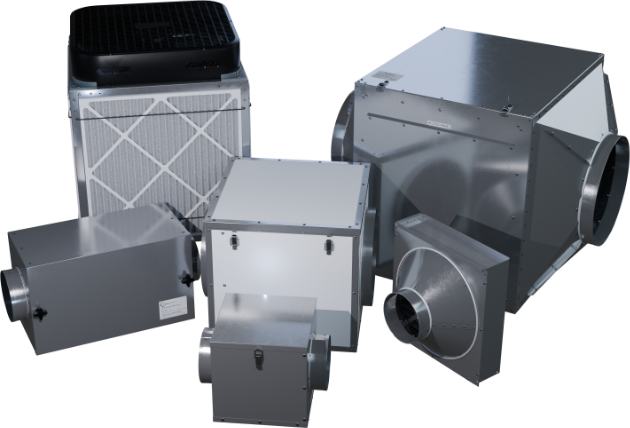
Unlike central furnace filter racks built for high-volume air handlers moving 1200+ CFM, inline filter boxes are designed for targeted, lower-volume duct runs operating between 100 to 500 CFM. Here are a couple of filter box applications:

  • ERV/HRV: When placed upstream of an ERV or HRV, it will pre-filter fresh outdoor air coming into the home delivering clean makeup air to living spaces.
  • Concealed filtration: In conjunction with an inline fan, these systems can be concealed in the ceiling creating a specialized HEPA filtration system that doesn’t clash with the aesthetics of the room.

Thanks to deep-pleat and V-bank/W-bank configurations, the expanded surface area significantly lowers static pressure drop and extends filter lifespan, making maintenance less frequent. When paired with the AirScape Digital Filter Monitor, differential pressure tracking provides timely, automated reminders when it is time for a filter swap to keep your system performing at peak efficiency.

CFB Series MERV-13 Inline Filter Boxes

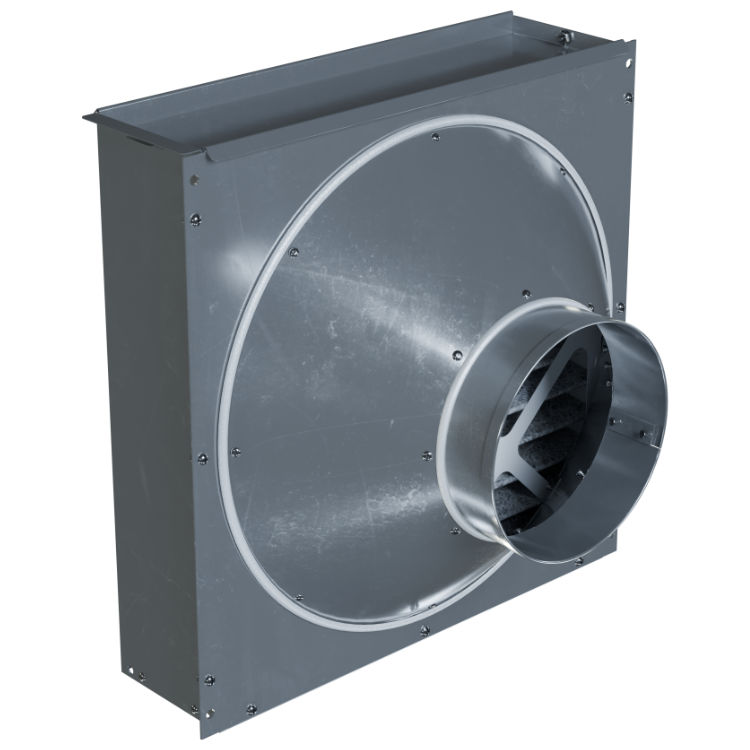
Designed for targeted airflow management in residential applications, this unit provides exceptional continuous particulate removal. With the sheer number of models the CFB has for different applications, it is our most versatile filter box.

  • Construction: Lightweight aluminum housing built for inline duct integration.
  • Filtration: Comes standard with 4-inch deep MERV-13 filters for maximum surface area and minimal static pressure loss. Upgradeable to MERV-15 or carbon-impregnated media for specialized odor control. Carbon filter only available for CFB-6 or CFB-8. CFB-6-OS model comes standard with MERV-15.
  • Duct Sizes: Sized for 6, 8, 10, and 12-inch ductwork. Special oversized model (CFB-6-OS) utilize a larger filter cabinet tapered to 6-inch collars to allow low airflow resistance.
  • Airflow:
    • MERV 13: Up to 2059 CFM maximum.
    • MERV 15: Up to 1415 CFM maximum.

CFB Product Page | CFB Specs


SFB-V Series MERV-13 V-Bank Inline Filter Boxes

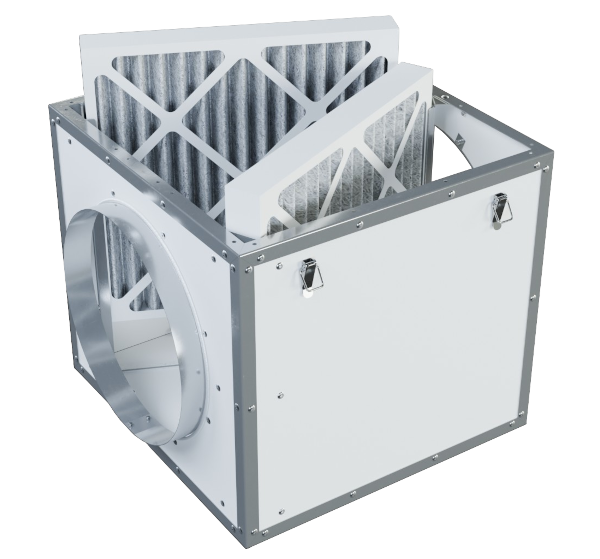
Engineered for applications where cabinet air loss cannot be tolerated, this unit minimizes system leakage across all operating speeds. It features toolless access latches that simplify routine servicing, making it an ideal choice for low-maintenance, tight- clearance installations.

  • Construction: Aluminum Composite Paneling (ACP) with full door and filter area gasketing for an ultra-low cabinet leakage profile.
  • Filter Configuration: V-bank filter arrangement coming standard with two 2-inch MERV 13 filters, upgradable to MERV 15.
  • Duct Sizes: Designed for 8, 12, and 14-inch duct systems.
  • Airflow:
    • MERV 13: Up to 2441 CFM maximum.
    • MERV 15: Testing data unavailable.

SFB-V Product Page | SFB-V Specs


IFWB Series W-Bank Insulated High Flow Inline Filter Boxes

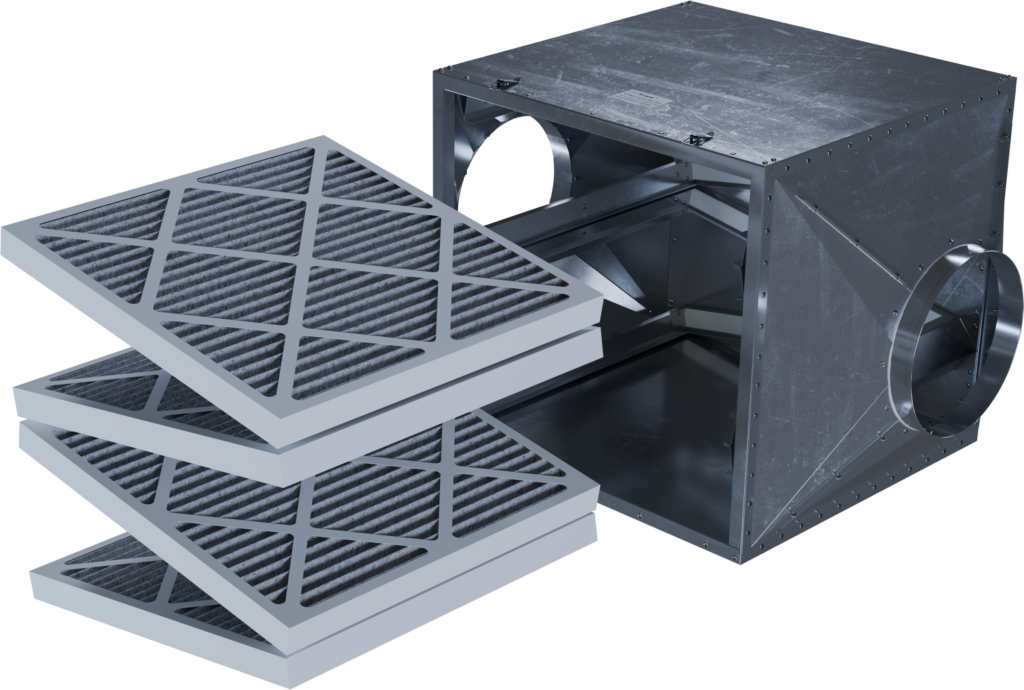
Built specifically to manage continuous high-volume airflow across demanding commercial and large-scale residential layouts. Its specialized internal design maximizes active surface area to ensure high volumetric flow rates while keeping pressure drop to an absolute minimum.

  • Construction: .04 double-walled aluminum insulated with 1-inch R4.3 fiberglass along 4 sides.
  • Filter Configuration: W-bank filter arrangement coming standard with 4 2-inch MERV 13 filters, upgradable to MERV 15.
  • Duct Sizes: Designed for 10, 12, 14, 16, 18, or 20-inch duct systems.
  • Airflow:
    • MERV 13: Up to 4962 CFM maximum.
    • MERV 15: Up to 4721 CFM maximum.

IFWB Product Page | IFWB Specs


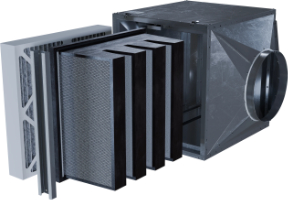
IFHB Series Inline HEPA Filter Boxes

Delivers heavy-duty air scrubbing capability engineered for high-demand environments such as welding, fabrication, or industrial processing. It offers the ultimate protection against heavy airborne particulate loads with medical-grade filtration.

  • Construction: .04 double-walled aluminum insulated with 1-inch R4.3 fiberglass along 4 sides.
  • Filter Configuration: 4-inch MERV 11 pre-filter with a 12-inch H13 medical-grade HEPA main filter.
  • Duct Sizes: Designed for 10, 12, 14, 16, 18, or 20-inch duct systems.
  • Airflow: Up to 1603 CFM maximum.

IFHB Product Page | IFHB Specs


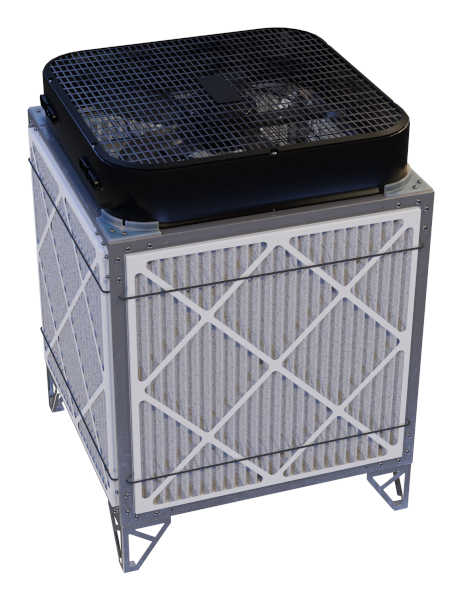
CRFB Corsi-Rosenthal Style Filter Cube

Operates as a high Clean Air Delivery Rate (CADR) ambient air cleaner designed to scrub room air without requiring direct integration into primary HVAC supply lines. it offers an efficient, flexible solution for localized space scrubbing, workshops, or high-occupancy areas.

  • Configuration: DIY filter setup designed for 20-inch box fans.
  • Filtration: Employs five MERV-13 filters assembled into a high-surface-area filtration cube.
  • Application: Cost-effective, high-CADR ambient air cleaning without inline duct modification.
  • Airflow: Variable with box fan performance, our tests showed 454 CFM.

CRFB Product Page | CRFB Specs

High-performance air filtration is essential for protecting expensive mechanical equipment, maintaining optimal system static pressure, and delivering clean indoor air. Explore our complete line of filter boxes, replacement media, and technical accessories at HVACquick.com.

Your dependable Partner for High-Performance products

Our engineering team is just a quick phone call away to provide expert guidance and ensure you have the right specialized gear for every job. Plus competitive contractor pricing, deep stocking and quick shipping from our East and West warehouses.

Join our TradePro program for below-MAP tier pricing, direct-dial engineering support and priority shipping.